General requirements:
1. The classroom lights and blackboard lights bid for in each bid section shall be products of the same brand from the same manufacturing enterprise.
This clause is a substantive requirement and condition that does not allow deviation. In case of any deviation, the bid shall be treated as invalid during the compliance review.
2. An appropriate number of classroom lights and blackboard lights shall be installed in each classroom, meeting and not lower than the requirements of national standards such as GB 50034-2013 Standard for Lighting Design of Buildings and GB 7793-2010 Hygienic Standard for Day Lighting and Artificial Lighting for Middle and Elementary School.
Specific technical specification requirements (Bid Section One, Bid Section Two, Bid Section Three)
| Serial No. | System name | Technical parameters |
| 1 | LED classroom light | 1. The classroom light shall be an integrated LED microcrystalline anti-glare panel light. The main body material of the luminaire shall be a non-deformable, oxidation-resistant metal material. The frame shall be made of lightweight metal materials such as aluminum alloy, with surface anti-rust treatment such as oxidation or spray painting. There shall be no accessible sharp corners or acute angles overall. The overall structure shall be sturdy and stable. The connection method shall be embedded plus screw and nut fixation to avoid safety hazards. 2. Classroom light power <45W.★3.Classroom light color rendering index Ra >90, special color rendering index R9 >50.★4. Classroom light luminous efficacy (or luminaire efficacy) >75 lm/W.★5. Classroom lights shall meet a 6000-hour luminous flux maintenance rate >92%.★6. To prevent light decay of the lamp body itself caused by dust and other reasons, it shall have a protection rating of IP40 or above.★7. The blue light hazard rating of classroom lights shall be RG0 (or Risk Group 0).★8. Classroom lights must be flicker-free and harmless. 9. To prevent glare and avoid eye discomfort, classroom lights must be lighting fixtures that have undergone scientific uniform light treatment and provide visual comfort, using optical anti-glare diffuser panels. 10. The driver power supply of classroom lights must be an isolated constant-current driver, with the power supply housed in an enclosure and reliably fixed. ★11. Classroom lights must use a sufficient number of low-power LED beads. The actual operating power of the beads should not exceed 50% of the rated power to improve luminous efficiency and reduce lumen depreciation of the fixture, and classroom lights must pass CCC certification. ★12. Classroom light color temperature (or correlated color temperature) 4300K-5300K.★13. After classroom lights are installed, the maintained average illuminance on desk surfaces must be ≥300Lx (maintenance factor 0.8), illuminance uniformity ≥0.7, and lighting power density for ordinary classrooms (excluding blackboard lights) ≤7W/m2. Classroom lighting unified glare rating UGR<19. |
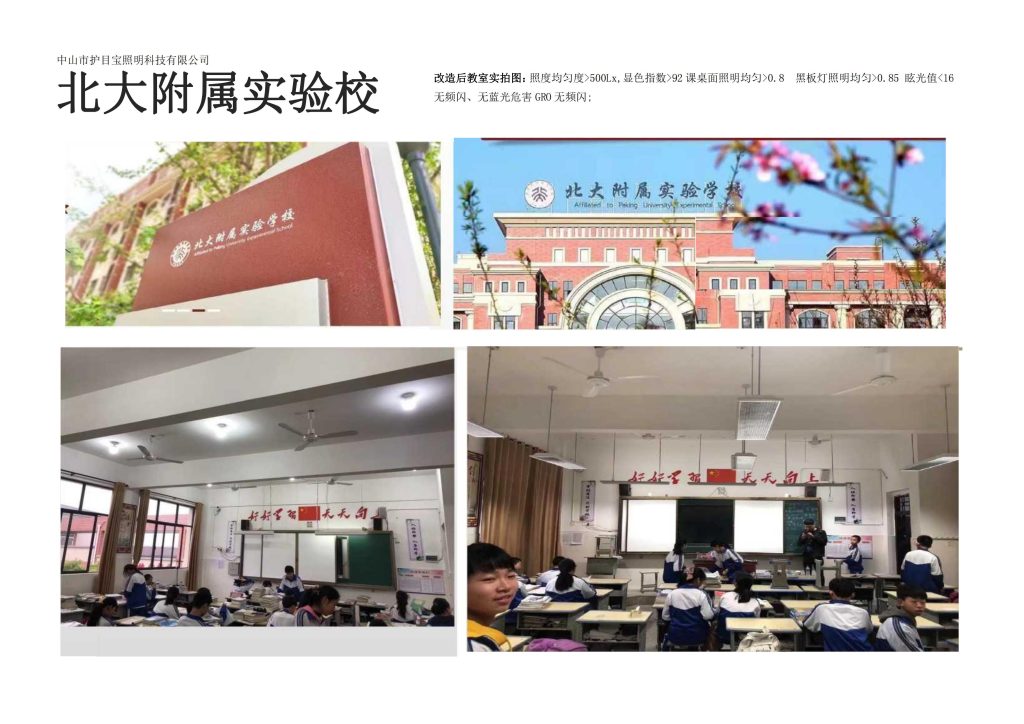
| 2 | LED blackboard light | 1. The blackboard light shall be an integrated LED anti-glare fixture. The main body material of the fixture shall be a non-deforming, oxidation-resistant metal material. The frame shall use lightweight metal materials such as aluminum alloy, with surface treatment such as anodizing or spray painting for rust prevention. There shall be no accessible sharp corners or acute angles. The overall structure shall be sturdy and stable. The connection method shall be embedded plus screw-and-nut fixation to avoid safety hazards. 2. Blackboard light power <45W.★3.Blackboard light color rendering index Ra>90, special color rendering index R9>50.★4. Blackboard light luminous efficacy (or luminaire efficacy) >75 lm/W.★5. Blackboard lights shall meet a 6000-hour lumen maintenance rate >92%.★6. To prevent lumen depreciation of the fixture itself caused by dust and other reasons, it shall have a protection rating of IP40 or above.★7. The blue light hazard rating of the blackboard light shall be RG0 (or Risk Group 0).★8. Blackboard lights must be flicker-free and harmless. 9. To prevent glare and avoid eye discomfort, blackboard lights must be lighting fixtures that have undergone scientific uniform light treatment and provide visual comfort, using optical anti-glare diffuser panels. Grilles or other anti-glare structures shall be used. 10. The driver power supply of blackboard lights must be an isolated constant-current driver, with the power supply housed in an enclosure and reliably fixed. ★11. Blackboard lights must use a sufficient number of low-power LED beads. The actual operating power of the beads should not exceed 50% of the rated power to improve luminous efficiency and reduce lumen depreciation of the fixture, and classroom lights must pass CCC certification. ★12. Blackboard light color temperature (or correlated color temperature) 4300K-5300K.★13. After blackboard lights are installed, the maintained average illuminance in the classroom blackboard area must be ≥500Lx (maintenance factor 0.8), and the illuminance uniformity in the classroom blackboard area must be ≥0.8. |
Notes:
(1) Items marked with "★" above are important response indicators.
(2) Items not marked with "★" above are non-important response indicators.
(3) All indicators marked with "★" above require certification certificates issued by nationally legally recognized certification bodies or test reports issued by third-party testing institutions with CMA, ILAC-MRA, and CNAS marks on the cover. (The report must clearly indicate the specification standards on which the testing is based, product images, inspection and testing data, etc., and the marked tested product model must be consistent with the specification and model of the product being bid.) The classroom lamps and blackboard lamps being bid must have CCC certification certificates. Scanned copies of the above certification certificates or test reports must be provided in the bid documents.
(4) All scanned copies of certification certificates or test reports must be verified against the originals during bidding to be valid.
Bid document requirements:
1. The bid documents shall include the "Technical Specifications of the Products Being Bid" document.
2. The content of the "Technical Specifications of the Products Being Bid" shall be prepared in accordance with the above "(I) General Requirements" and "(II) Specific Technical Specification Requirements."
Applicable Standards
(I) Reference Standards for Classroom Lighting Products
1. IEC/TR 62778:2014 "Application of IEC 62471 for the Assessment of Blue Light Hazard to Light Sources and Luminaires"
2. IEEE Std 1789-2015 "IEEE Recommended Practices for Modulating Current in High-Brightness LEDs for Mitigating Health Risks to Viewers"
3. GB 19510.14-2009 "Particular Requirements for DC or AC Electronic Controlgear for LED Modules"
4. GB 7000.1-2015 "Luminaires - Part 1: General Requirements and Tests"
5. GB 7000.201-2008 "Luminaires - Part 2-1: Particular Requirements - Fixed General Purpose Luminaires"
6. GB/T 31831-2015 "Technical Requirements for LED Indoor Lighting Applications"
(II) Reference Standards for Classroom Lighting Quality
1. GB 50034-2013 "Standard for Lighting Design of Buildings"
2. GB 7793-2010 Hygienic Standard for Daylighting and Lighting in Primary and Secondary School Classrooms
3. GB/T 5700-2008 Measurement Methods for Lighting
4. GB/T 36876-2018 Hygienic Requirements for Lighting Design and Installation in Ordinary Classrooms of Primary and Secondary Schools
5. GB 40070-2021 Hygienic Requirements for Myopia Prevention and Control of Learning Supplies for Children and Adolescents
6. T/JYBZ 005-2018 Technical Specification for Classroom Lighting in Primary and Secondary Schools
7. DB3201/T 1006—2020 Acceptance Management Specification for Classroom Lighting in Primary and Secondary Schools and Kindergartens
Project Implementation Requirements
1. Delivery time requirements: All contract deliverables shall be delivered within 30 days after the contract takes effect, with installation and commissioning completed and acceptance passed.
2. Delivery and installation location: The location designated by the purchaser.
Note: This "(I) Delivery Requirements" constitutes substantive requirements and conditions that do not allow deviation. In case of any deviation,it shall be treated as an invalid bid during the compliance review.
(II) Specific Project Implementation and Installation Requirements
1. Dismantling requirements
Dismantle the existing classroom lamps and blackboard lamps, and replace them with classroom lamps and blackboard lamps (including light sources) that meet the renovation requirements.
Demolition of existing blackboard lights, classroom lights, and other items affecting luminaire installation in ordinary classrooms (ceiling fans, projector mounts, TV mounts, etc., subject to school approval).
Demolished luminaires and other items shall be handed over to the school in good condition for retention.
2. Implementation requirements for cables and auxiliary materials:
(1) All relevant cables and auxiliary materials required for the implementation of this project shall be borne entirely by the seller (winning bidder).
(2) Power switch: 3C certified, non-recycled flame-retardant PC material housing, multi-gang single-control; after wiring, all existing 86-type switches shall be replaced; the blackboard light switch must be located on the blackboard side, so that the corresponding blackboard light can be turned off conveniently when using display equipment.
(3) Wiring: Power cables shall be 3C certified and shall have a cross-sectional area of ≥2.5mm2power cables. Existing concealed conduits may be reused; if not usable, surface-mounted conduits shall be installed; existing power cables with a wire diameter less than 2.5mm2must be replaced; newly installed power cables on walls and ceilings shall be placed in flame-retardant PVC trunking, and the sum of the maximum cross-sectional areas of all cables laid in the trunking shall not exceed 75% of the trunking cross-section. For PVC trunking at internal corners, external corners, flat bends, branch tees, end caps and other nodes, standard adapter fittings shall be used, not hand-cut miters; in surface-mounted ceiling wiring, the trunking size shall match the junction box hole diameter and be connected tightly; (for existing power cables, power wiring shall ensure that the phase, neutral, and ground wires are consistent in color and distinguishable.) The connections at both ends of power cables to the power supply and luminaire conductors must use terminal blocks; terminal blocks shall not be left hanging in the air and shall be secured with screws. Except at terminal boards and equipment connection points, power cables shall have no joints in the middle of the run, and conductor insulation shall be in good condition; when connecting two power cables, the conductors shall be connected tightly and firmly, and the resistance value of the joint shall not be greater than that of a conductor of the same length; the insulation strength of the joint between two power cables shall be the same as that of the non-jointed sections. Power cables placed in hanger rods shall not be wrapped around the hanger rods or left exposed in the air. Both ends of the hanger rods shall be protected with insulating sleeves. Wall damage caused during implementation shall be fully repaired.
(4) Trunking
Connector fittings shall be used at trunking joints, and the joints of the trunking body shall be tight, flat, and seamless.
Trunking shall be installed tightly against the building surface, and trunking routing shall be horizontal and vertical, with the trunking edges fixed along the building surface. Attachment fixing points shall be provided at turns and joints; each single trunking section shall have at least two fixing points; when a single section exceeds 1 meter in length, at least two fixing points per meter on average shall be provided. Fixing shall use expansion screws or wooden wedges; double-sided tape fixing is prohibited.
(5) Branch circuit control requirements
Each blackboard luminaire shall be controlled by a separate switch circuit, and each 86-type lighting switch shall control no more than 3 classroom luminaires.
Blackboard lights shall not share the same power cables and control switches as classroom lights. During classroom renovation, if the power cables of blackboard lights and classroom lights are not separated, the power cables and trunking for blackboard lights shall be newly laid; if the control switches of blackboard lights and classroom lights are not separated, control switches shall be added (or adjusted) so that branch circuit control of blackboard lights and classroom lights can ultimately be achieved.
If the existing classroom lights already have branch circuit control, then during renovation, when adding, reducing, or relocating luminaires, wiring construction shall be carried out according to the original luminaire branch circuit control, maintaining consistency of classroom light branch circuit control after renovation.
(6) Power-on trial operation
After the luminaires are installed, a power-on trial operation shall be carried out. Check whether the light sources in the luminaires operate normally, whether the projection direction and angle of the blackboard luminaires are correct, and the intact operation rate of the luminaires shall reach 100%.
(3). Luminaire installation requirements
(1) The minimum suspension height of the luminaires from the desk surface is 1.7m. Non-recessed luminaires shall be installed with rigid suspension rods. The suspension rods shall be perpendicular to the luminaire surface and shall not be tilted. The spacing deviation between two rods shall be ±5 mm. The luminaires shall be arranged with their long axis perpendicular to the blackboard writing area. The luminaires shall be installed symmetrically, and their transverse (longitudinal) central axes should preferably be on the same straight line, with a deviation not greater than 20mm.
(2) Luminaires installed with suspension rods shall be fixed with expansion bolts of not less than 6mm, and the load-bearing capacity of embedded parts shall not be less than 10 times the weight of the luminaires.
(3) The luminaires and their accessories shall be installed completely, without defects such as damage, deformation, coating peeling, and lampshade cracking; the luminaire wiring shall be firm and have good contact.
(4) During luminaire installation, care shall be taken to avoid obstruction of other equipment (such as surveillance cameras, projectors, ceiling-mounted air conditioners); if the light is obstructed by building components, the horizontal installation position of the luminaires shall be adjusted within the limit values or the installation height of the luminaires shall be lowered; in classrooms with fans installed, the light exit surface shall be lower than the fan blades.
(4). Quality control
In implementing on-site quality management, strictly follow the specification requirements, establish a complete quality management system, comprehensively control the implementation process, and ensure that the implementation quality of each procedure meets the standards. The quality of implementation at each stage shall be self-inspected and self-checked, and the purchaser (buyer) shall track and supervise the entire process with strict quality control.
(1) Quality supervision during the installation stage
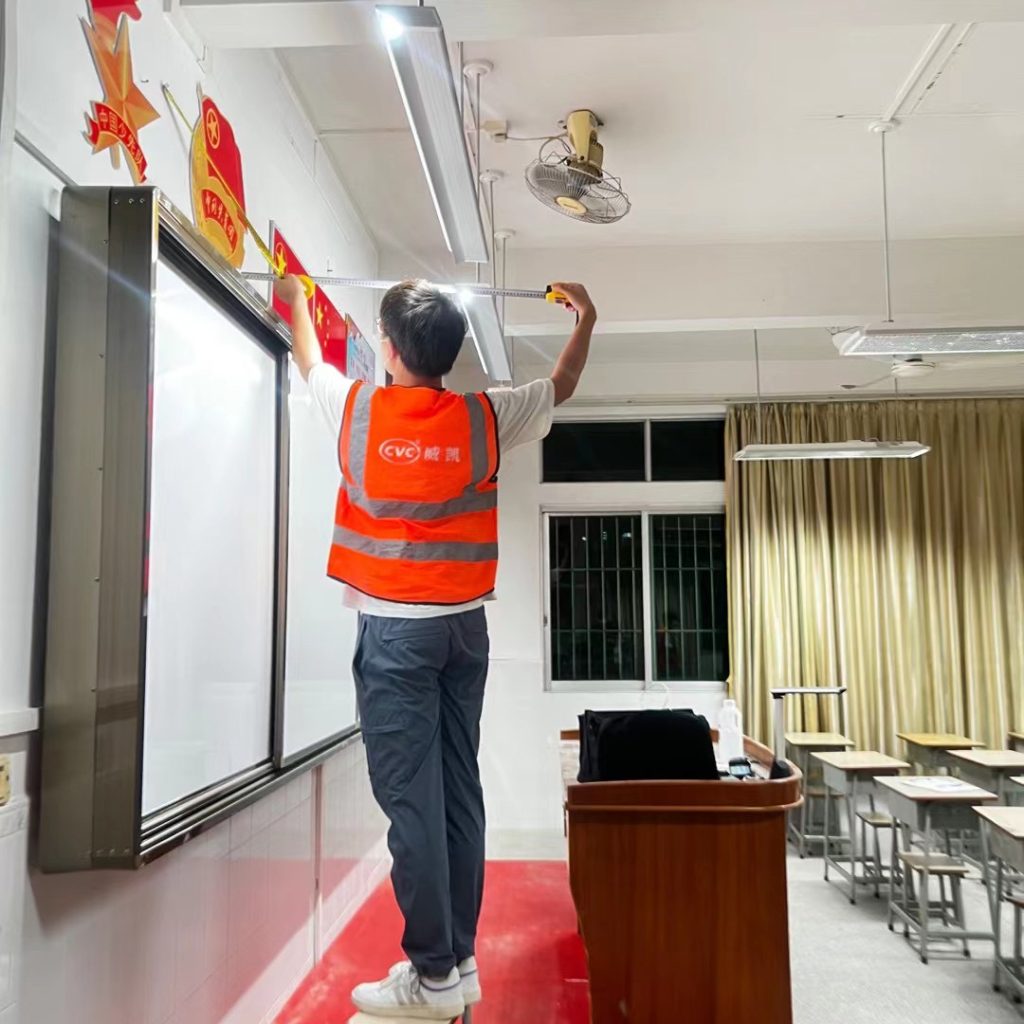
① Within 2 working days after the installation at each school is completed, the school shall verify the average illuminance value, uniformity, etc. of the classroom, and record and photograph the installation safety requirements, switch installation positions, fan position handling, and other aspects.
② The relevant responsible persons of each school shall participate in the installation quality supervision work, irregularly inspect whether there are any violations of installation procedures, specifications, and regulations during the installation process, take proper safety protection measures, and promptly rectify problems such as unqualified items and accident signs.
(2) Installation testing conditions
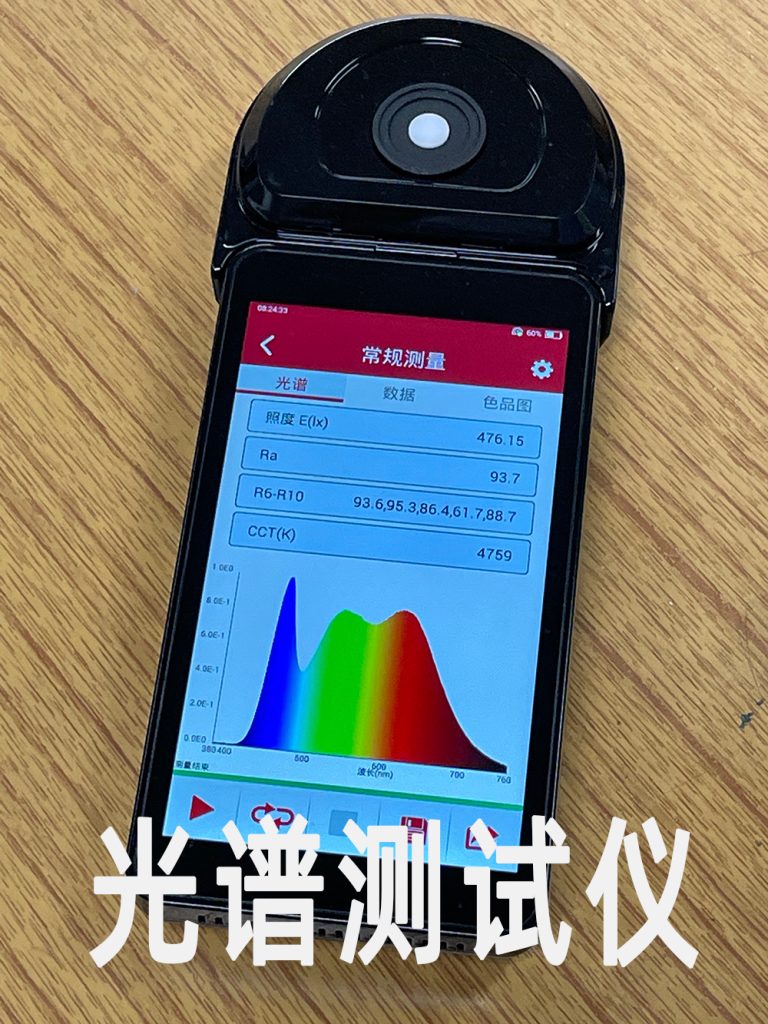
The winning bidder (seller) shall have spectral illuminance flicker testing equipment, conduct self-testing after the installation of each type of classroom, and promptly submit the self-test data to the purchaser (buyer), and the purchaser (buyer) shall conduct random re-testing.