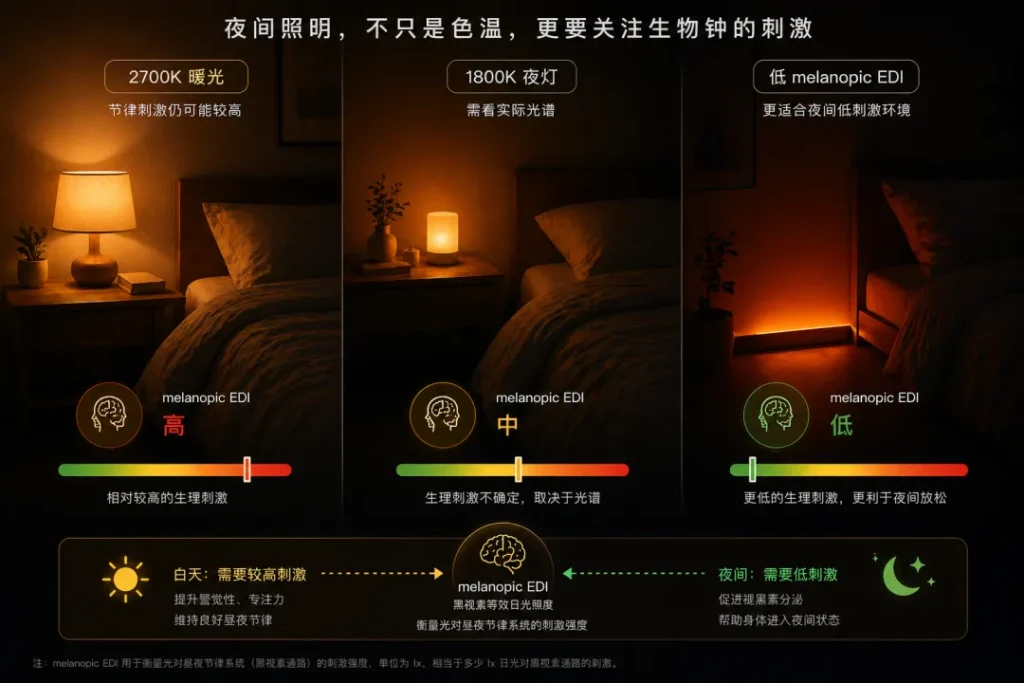
When many people think of nighttime lighting, they think of "warm light." A lower color temperature, a yellower beam, a softer look — it seems naturally more suitable for use before bed. But from the perspective of circadian lighting and healthy lighting, that is not the case. A 2700K lamp may still produce a high level of physiological stimulation. An 1800K night light is not necessarily suitable for the pre-sleep environment either. What really matters is not just the color temperature, but how much stimulation this light produces in the human circadian system after entering the eye. This brings in an indicator that has become increasingly important in healthy lighting in recent years:melanopic EDI (melanopic equivalent daylight illuminance).
1. Why should nighttime lighting pay attention to melanopic EDI?
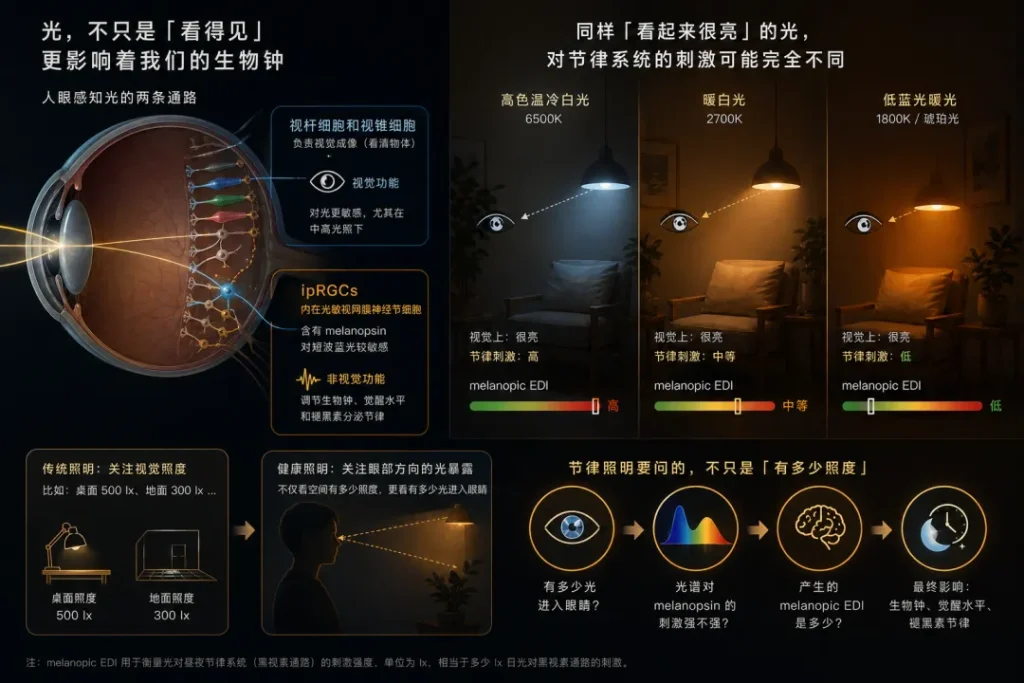
The human eye does not perceive light only through rods and cones. In the retina there is also a class of photoreceptive cells closely related to the circadian rhythm, calledipRGCs, namely intrinsically photosensitive retinal ganglion cells. They contain a photopigment calledmelanopsin, are relatively sensitive to the short-wavelength blue region, and participate in regulating the human body clock, alertness level and melatonin secretion rhythm. So the same "visually bright" light can have completely different circadian stimulation effects on the human body depending on its spectrum. Traditional lighting design focuses more on visual illuminance, such as how many lx on the desk or how many lx on the floor. Healthy lighting further focuses on light entering the eye, that is, light exposure in the direction of the eye. This is why, in circadian lighting, one cannot only ask: how much illuminance does this space have? One must also ask: how much of this light enters the eye?
Is its spectrum strongly stimulating to melanopsin?
What melanopic EDI does it produce?
2. What recommendations does CIE TN 015:2023 give?
CIE TN 015:2023 is an important technical document on circadian and neurophysiological light reception. It puts forward recommendations for light exposure at different time periods, among which those for evening and nighttime lighting deserve particular attention. The core recommendations in the document can be summarized as follows:In the evening phase, starting at least 3 hours before bedtime, the recommended maximum melanopic EDI should not exceed 10 lx.In the nighttime phase, the recommended ambient melanopic EDI should not exceed 1 lx, and the sleep environment should be kept as dark as possible.If at night there is indeed a need to get up, provide care, move around or perform other unavoidable visual activities, only then is it recommended to return to a level of no more than 10 lx melanopic EDI. There are several key points here. First, what CIE refers to is melanopic EDI, not ordinary illuminance. Second, the evaluation position should be as close as possible to the direction of the human eye, rather than only looking at desk or floor illuminance. Third, evening and nighttime are two different scenarios and cannot be conflated. Fourth, such recommendations serve healthy light exposure management, are not equivalent to any kind of product certification, and cannot be used directly as a basis for commercial claims of "sleep-aid efficacy."
III. Why does low color temperature not equal low circadian stimulation?
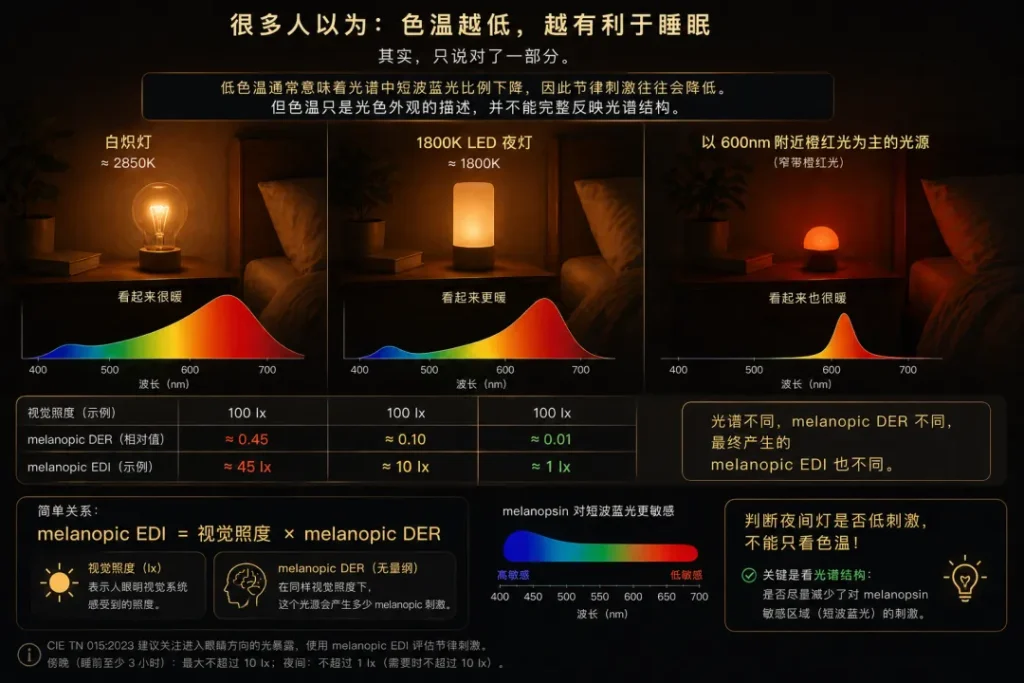
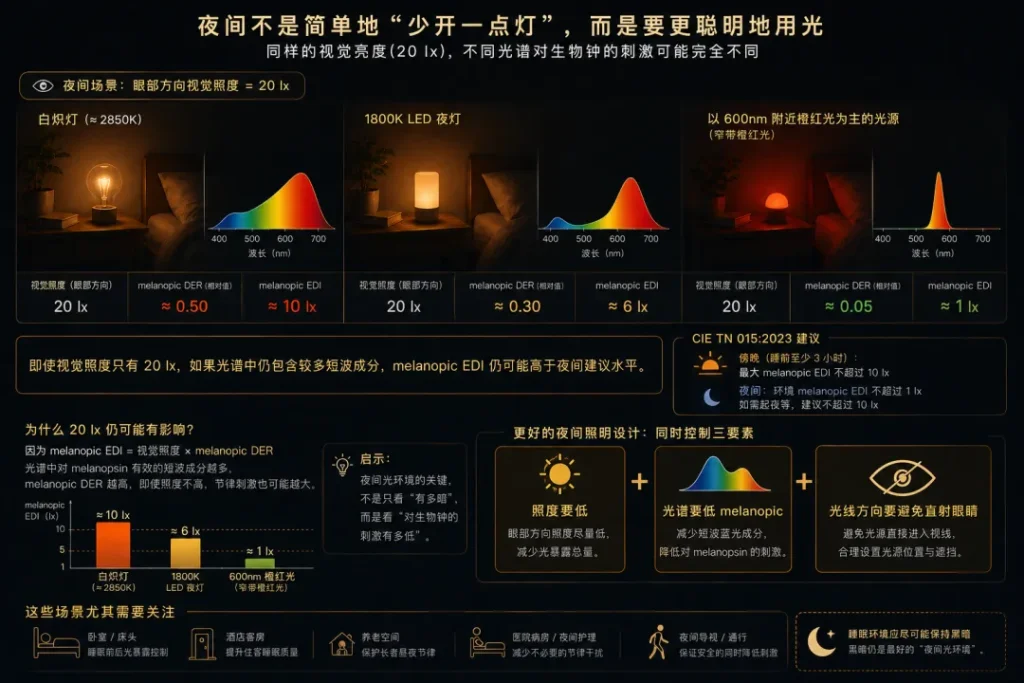
Many people assume that as long as the color temperature is low enough, it is necessarily friendlier to sleep. This judgment is only partly correct. Low color temperature usually means a reduced proportion of short-wavelength blue light in the spectrum, so circadian stimulation tends to decrease. But color temperature is only a description of the light's color appearance and cannot fully reflect the spectral structure. A simple example: an incandescent lamp at about 2850K looks warm. An 1800K LED night light looks warmer. A light source dominated by orange-red light near 600nm also looks warm. All three can be classified as warm light, but their spectral distributions differ greatly. Different spectra mean different melanopic DER, and ultimately different melanopic EDI. A simple relationship can help understand this:melanopic EDI = visual illuminance × melanopic DERVisual illuminance represents the illuminance perceived by the human eye's photopic vision system. Melanopic DER can be understood as: at the same visual illuminance, how much melanopic stimulation this light source produces. Therefore, to judge whether a night light is low-stimulation, you cannot look only at whether it is 2700K, 2200K, or 1800K. More critical is whether its spectrum minimizes stimulation of the melanopsin-sensitive region.
IV. Three types of night light sources seen through a comparison chart
↑Figure: The image comes from the comparison chart in the Yuji Lighting attachment, showing three types of light sources: incandescent lamp, about 2857K. LED night light, about 1800K. FlameWarm™-type light source, main band about 600nm, typical color temperature about 1250K. In the evening scenario, the chart sets the visual illuminance toward the eye to 100 lx. For the incandescent lamp at 100 lx, melanopic EDI is about 50 lx. For the 1800K LED night light at 100 lx, melanopic EDI is about 28 lx. For the 600nm orange-red spectrum at 100 lx, melanopic EDI is about 6 lx. The core conclusion this set of data aims to convey is: at the same 100 lx, all appear to have a certain brightness, but the circadian stimulation brought by different spectra differs very significantly. Although the incandescent lamp is very warm, at 100 lx eye illuminance its melanopic EDI is still significantly higher than the CIE evening recommendation of 10 lx. The 1800K LED night light is lower than the incandescent lamp but still exceeds 10 lx. A low-melanopic spectrum near 600nm can maintain a certain visible brightness while controlling melanopic EDI to a lower level. This indicates a very important design direction:The key to bedtime lighting is not just making the light warm, but making the spectrum lower in melanopic content.
5. Why can 20 lx at night still be "too stimulating"?
In the comparison chart, the visual illuminance toward the eye in the nighttime scene is set at 20 lx. For an incandescent lamp at 20 lx, the melanopic EDI is approximately 10 lx. For an 1800K LED night light at 20 lx, the melanopic EDI is approximately 6 lx. For a 600nm orange-red spectrum at 20 lx, the melanopic EDI is approximately 1 lx. This set of data is more revealing. Many people believe that 20 lx is already very low and should have no effect. However, if the spectrum still contains a significant short-wavelength component effective for melanopsin, even if the visual illuminance is not high, the melanopic EDI may still exceed the recommended nighttime level. This is also the most easily overlooked aspect of nighttime lighting design. Nighttime lighting is not simply "turning on fewer lights." A better approach is to simultaneously control three factors:Illuminance should be low.The spectrum should be low melanopic.The direction of light should avoid shining directly into the eyes.This is especially critical in scenarios such as bedrooms, bedside areas, hotel guest rooms, elderly care spaces, hospital wards, nighttime nursing, and nighttime wayfinding.
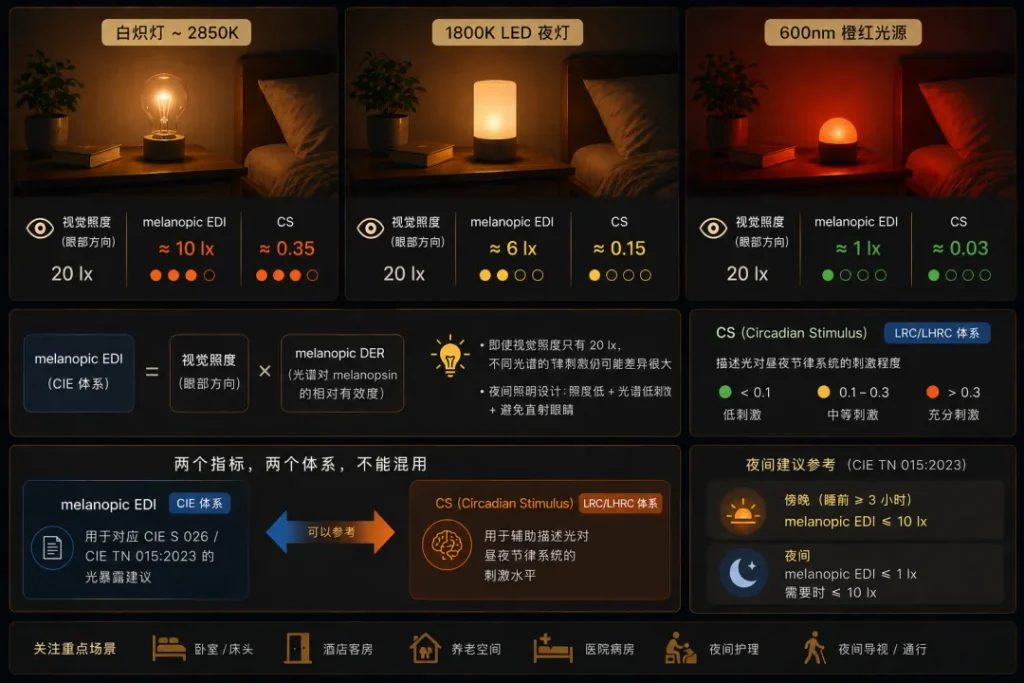
6. What is the CS value? Is it the same as melanopic EDI?
In addition to melanopic EDI, there is also the CS value. CS stands for Circadian Stimulus. It originates from the Lighting Research Center / Light and Health Research Center framework and is used to describe the degree of stimulation that light exerts on the circadian system. Generally speaking, a higher CS value represents stronger circadian stimulation. Some references treat CS below 0.1 as lower stimulation, 0.1 to 0.3 as moderate stimulation, and above 0.3 as relatively sufficient stimulation. However, special attention should be paid here:CS and melanopic EDI are not the same evaluation system.melanopic EDI belongs to the α-opic metrology system adopted by CIE S 026 and CIE TN 015:2023. CS belongs to the LRC/LHRC model system. Both can be used for healthy lighting and circadian lighting analysis, but they cannot be mixed, and one must not write "what CS value does CIE recommend." If these two metrics are used in technical articles, product white papers, or project documents, it is recommended to present them separately: melanopic EDI is used to correspond to CIE light exposure recommendations. CS is used to supplement the description of the stimulation level that light exerts on the circadian system. The two can reference each other but cannot replace each other.
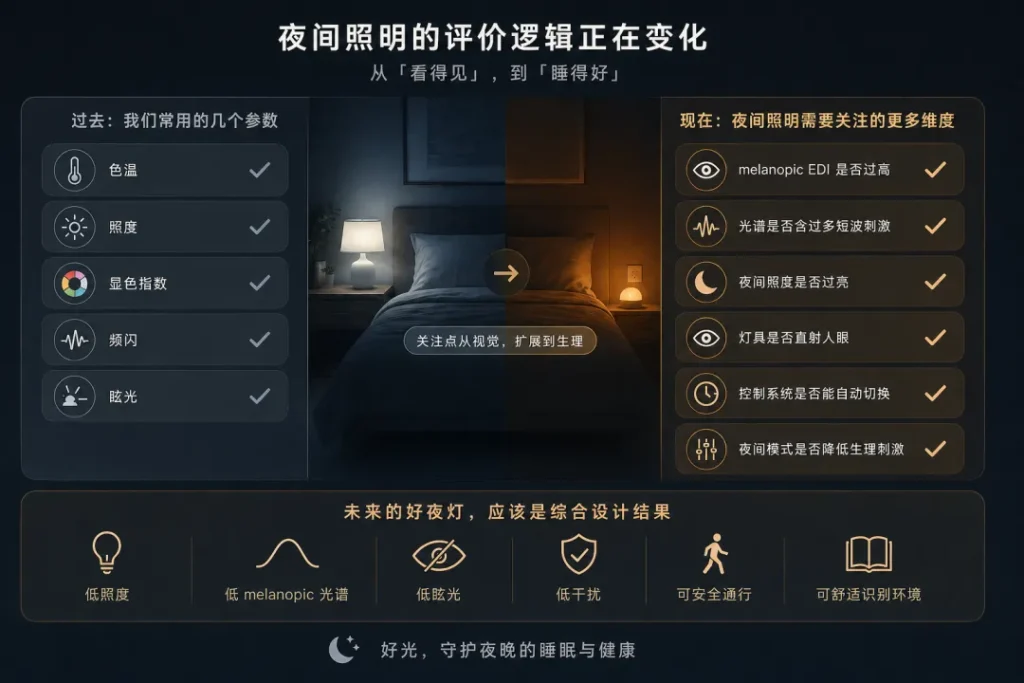
7. What implications does this have for the lighting industry?
The evaluation logic of nighttime lighting is changing. In the past, we often used a few simple parameters to judge a lamp: What is the color temperature? Is the illuminance sufficient? Is the color rendering index high? Is there flicker? Is glare control good? These metrics are still important. But in scenarios such as bedrooms, elderly care, hotels, healthcare, and children's nighttime activities, further attention is needed: Is melanopic EDI too high? Does the spectrum contain excessive short-wavelength stimulation? Is nighttime illuminance too bright? Does the luminaire shine directly into the eyes? Can the control system automatically switch over time? Does night mode truly reduce physiological stimulation? A good night light of the future is not just "warm." The bedtime light environment of the future is not just "dim." It should be a comprehensive design result:Low illuminance, low melanopic spectrum, low glare, low interference, safe passage, and comfortable environmental recognition.
VIII. Implications for Product Development
For lighting companies, there are several directions worth further development.
- From low color temperature to low melanopic DER
Simply lowering color temperature is no longer the most advanced nighttime lighting solution. A more valuable direction is to reduce melanopic DER through spectral design, decreasing circadian stimulation at the same visual illuminance. This means product R&D cannot focus only on CCT; it must also build an SPD spectral database, calculate melanopic EDI, melanopic DER, M/P ratio and other metrics, and integrate these metrics with actual application scenarios. 2. From single night lights to scene modes True nighttime lighting is not necessarily a standalone night light. It can be the night mode of a bedroom main light. It can be the bedtime mode of a bedside lamp. It can be the nighttime wake-up mode of a baseboard light. It can be a nighttime wayfinding system in hotel guest rooms. It can also be a care lighting system in elderly care spaces that balances safety and low stimulation. Product value lies not only in the light source itself, but also in the scene control logic. 3. From "eye protection" rhetoric to verifiable data Healthy lighting cannot rely on conceptual claims alone. If a product claims low circadian stimulation, it needs to provide verifiable data support, such as: spectral power distribution SPD; melanopic EDI at different dimming levels; eye-level illuminance at different installation distances and angles; lighting parameters under different scene modes; comparative calculations against ordinary warm white light and ordinary night lights. Only in this way can healthy lighting move from marketing language to engineering language.
IX. What principles can be followed when designing nighttime lighting?
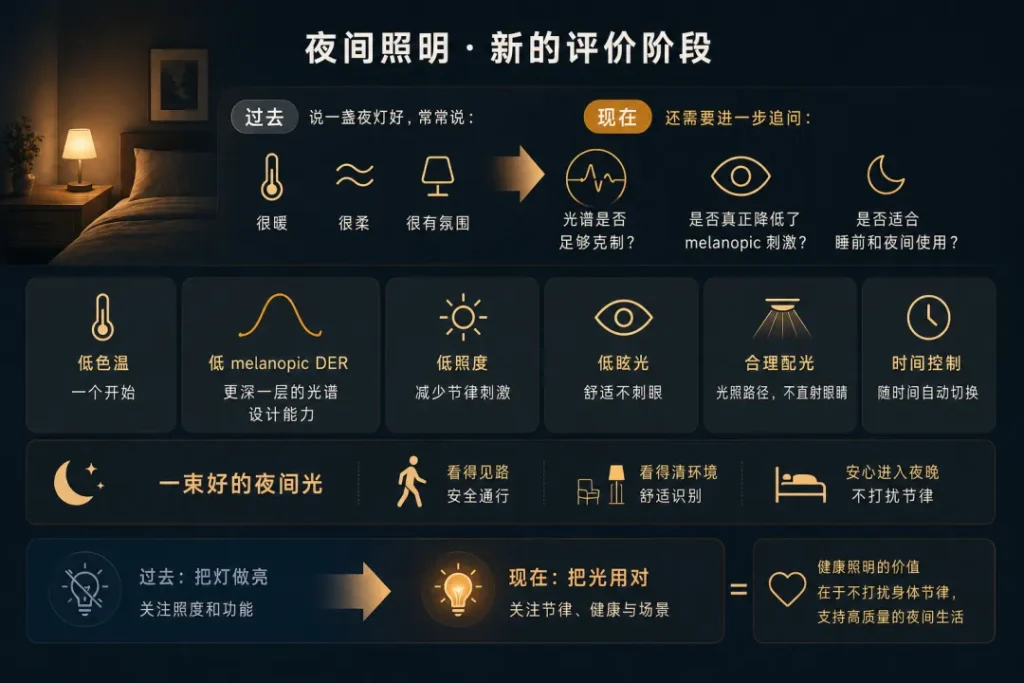
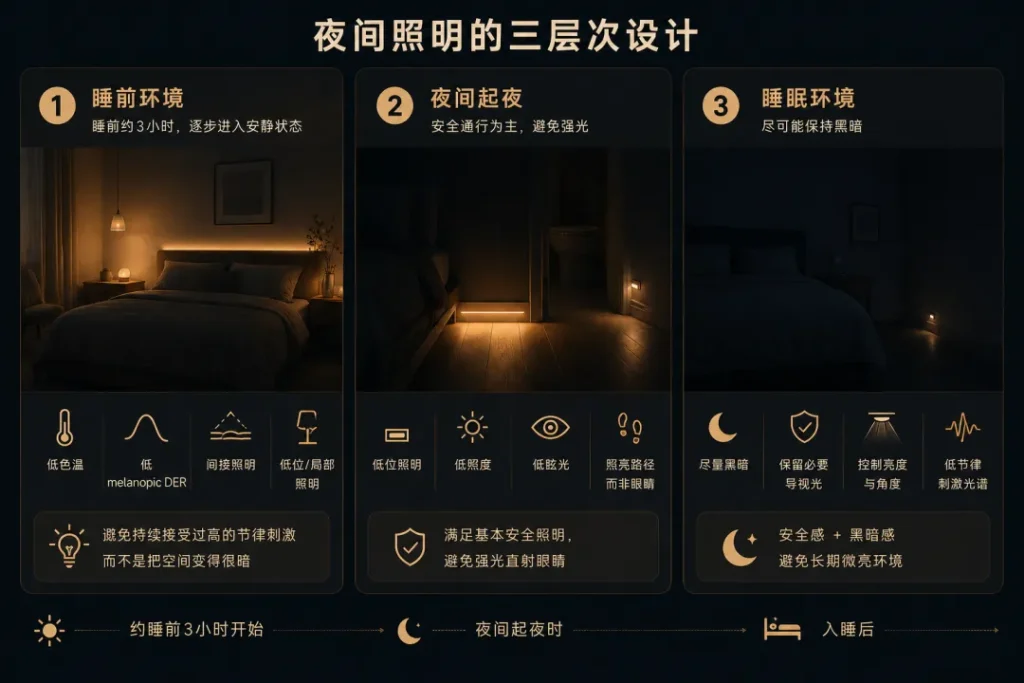
For designers and engineering applications, nighttime lighting can be divided into three levels. Level 1: Pre-sleep environment. About 3 hours before bedtime, it is recommended to gradually reduce spatial brightness and minimize high color temperature, high brightness, and large-area direct light. At this stage, light sources with lower color temperature and low melanopic DER can be used, combined with indirect lighting, low-position lighting, and local lighting, allowing the space to gradually enter a calm state. The key is not to make the space very dark, but to prevent the body from continuing to receive excessive circadian stimulation. Level 2: Nighttime bathroom trips. Nighttime bathroom trips require basic safety lighting, but strong light should be avoided. Low-position, low-illuminance, and low-glare lighting methods are more recommended, such as baseboard lights, under-bed sensor lights, footlights, and low-position wayfinding lights. Light should illuminate the path as much as possible, rather than shining toward people's eyes. Level 3: Sleep environment. After actually falling asleep, the environment should remain as dark as possible. If nighttime wayfinding light is indeed needed, brightness, angle, and spectrum should also be controlled to avoid continuous exposure to the eyes. The sense of safety and the sense of darkness in the sleep environment need to be balanced simultaneously; the bedroom must not become a permanently dimly lit environment for the sake of convenience.
10. Good nighttime light needs to move from looking comfortable to being physiologically restrained
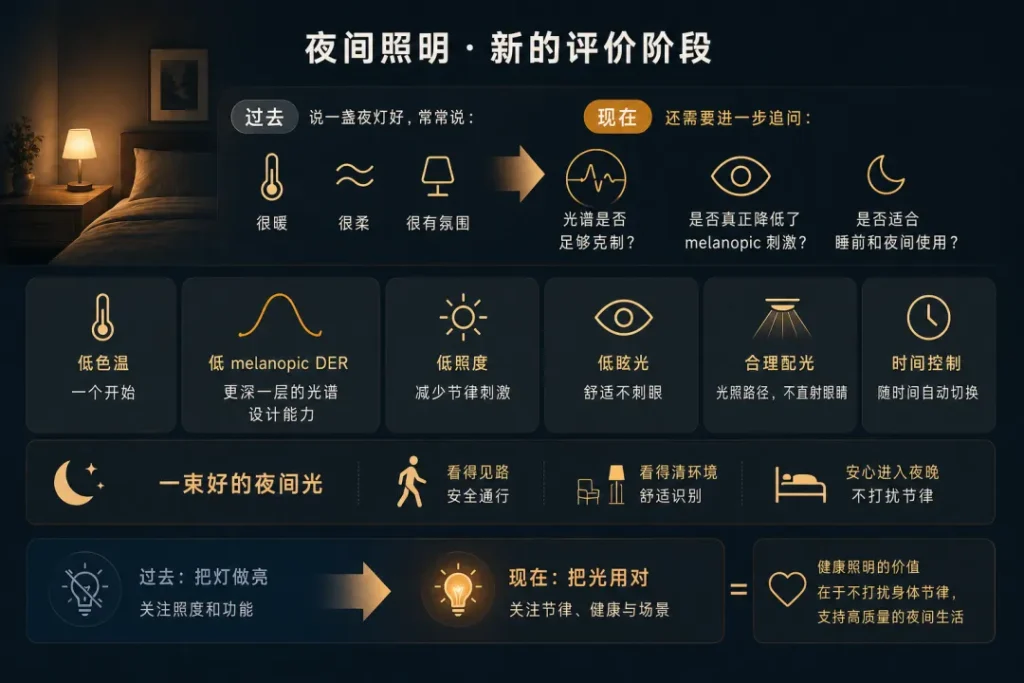
Nighttime lighting is entering a new evaluation stage. In the past, when we said a night light was good, we often said it was warm, soft, and atmospheric. Now we need to further ask: Is its spectrum sufficiently restrained? Has it truly reduced melanopic stimulation? Is it suitable for use before sleep and at night? Low color temperature is a beginning. Low melanopic DER is a deeper level of spectral design capability. Low illuminance, low glare, reasonable light distribution, and time control together constitute a complete nighttime lighting solution. A good beam of nighttime light should not disturb the body's rhythms. It should let people see the path, see the environment clearly, and also enter the night with peace of mind. The value of healthy lighting is moving from making lamps brighter to using light correctly. And pre-sleep and nighttime lighting are precisely one of the scenarios that best demonstrate this professional boundary.