New Focus in Classroom Lighting Procurement
In the past few years, when schools and education systems procured classroom lighting, their attention was mostly focused on whether illuminance met standards, whether there was flicker, and whether blue light hazard levels were compliant. These indicators are certainly important, but as buyers gain a deeper understanding of the light environment, a more fundamental question is being raised repeatedly: how far is the spectrum of this lamp from sunlight?
At several recent educational equipment exhibitions and lighting technology exchange events, spectrum charts are gradually replacing single parameter tables as the core basis for buyers evaluating eye-protection lamps. The reason is that illuminance, flicker, and blue light level are "threshold indicators" — meeting them is merely an entry ticket; while the continuity and fullness of the spectrum and the completeness of the beneficial red-light band truly determine the upper limit of visual comfort in long-term reading environments.
From a procurement practice perspective, the evaluation focus of classroom lighting is undergoing three shifts:
- From "looking at single-point values" to "looking at the full-band curve," focusing on whether the spectrum is continuous within the 380-780nm range and whether there are obvious dips;
- From "looking only at color rendering index Ra" to "placing equal emphasis on Ra and spectral shape" — a high CRI does not equate to a full spectrum;
- From "general eye protection" to "scenario-specific selection" — different teaching spaces have different needs for color fidelity and red-light content.
This change imposes new requirements on buyers: in tender documents and technical evaluations, suppliers should be required to provide verifiable relative spectral charts rather than merely parameter conclusions. Spectral charts do not lie — they visually present the energy distribution of the light source within the visible range and directly reflect the product's true level in terms of "closeness to sunlight."
Spectral Differences Affect Acceptance
In the acceptance phase of classroom lighting projects, buyers are usually accustomed to checking conventional parameters such as color rendering index (Ra), color temperature, and illuminance. But more and more education system buyers are finding that these indicators alone are insufficient to judge whether an eye-protection lamp is truly suitable for long-term reading and writing scenarios. The reason is that Ra measures the average rendering capability of a light source for standard color samples; it cannot fully reflect the continuity and fullness of the spectrum within the 380–780nm range, nor can it indicate the coverage of the beneficial red-light band.
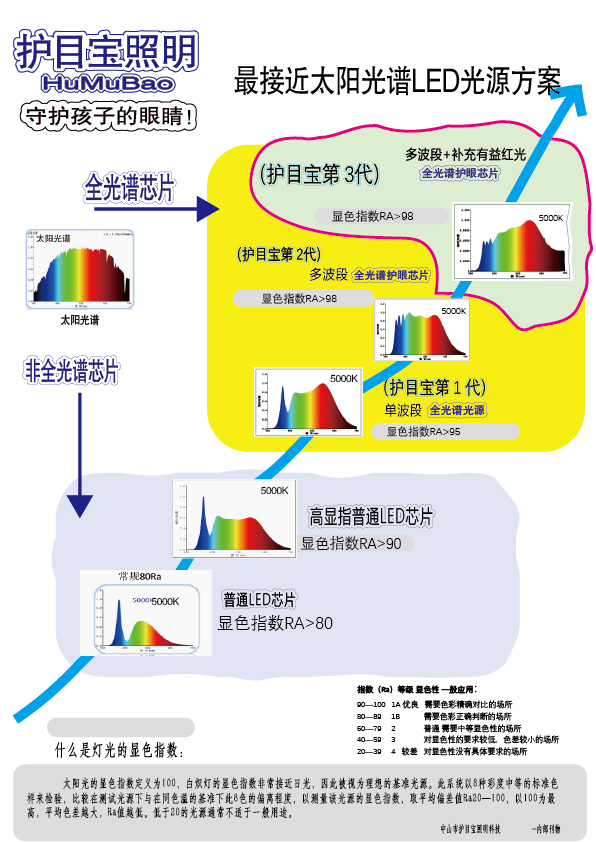
From the reference images provided by Zhongshan Humubao Lighting Technology, it can be seen that light sources of different technical routes show obvious differences in spectral shape. The second image divides light sources into two major categories: full-spectrum chips and non-full-spectrum chips. Non-full-spectrum chips include high-CRI ordinary LED chips and ordinary LED chips, while full-spectrum chips correspond to HUMUBAO third-generation products, with the solar spectrum as a reference. The image also lists the correspondence between color rendering index Ra grades and applicable venues — for example, Ra 90–100 is suitable for venues requiring precise color comparison. This means that even if two lamps have similar Ra values, whether their spectral curves are continuous and whether the beneficial red-light region is complete may still differ greatly.
For buyers, this difference directly affects acceptance judgments:
- Whether the spectral curve is continuous and full within the 380–780nm range, rather than showing obvious gaps or spikes;
- Whether the beneficial red-light region is complete, which relates to spectral comfort in long-duration eye-use environments;
- Whether the color rendering index grade matches the eye-use requirements of specific places such as classrooms, art rooms, and laboratories.
Therefore, it is recommended that acceptance documentation require suppliers to provide relative spectral graphs, not merely a set of Ra values. Spectral graphs can intuitively show how closely a light source approximates the solar spectrum, and also make it easier for buyers to make comparable and traceable technical judgments among different brands.
Evolution of Three Generations of Light Source Technology
In the field of eye-protection lighting, the generational differences in light source chips directly determine spectral completeness and eye-protection performance. HUMUBAO has gradually narrowed the gap between artificial light and the solar spectrum through continuous iteration of three generations of light source technology. From the first generation to the third generation, each generation of chips has achieved quantifiable improvements in spectral continuity, color rendering index, and beneficial red-light supplementation.
According to the relative spectral comparison materials provided by Zhongshan HUMUBAO Lighting Technology, the technical paths of the three generations of products are clearly distinguishable:
- 1st Generation — Single-band full-spectrum light source:As an early full-spectrum solution, it already had basic continuity in the 380-780nm range, but the spectral curve showed obvious dips in some bands, and coverage of the beneficial red-light region was relatively limited.
- 2nd Generation — Multi-band full-spectrum eye-protection chip:Through multi-band light supplementation technology, spectral fullness is significantly improved compared with the first generation, curve smoothness is enhanced, and color rendering performance is simultaneously strengthened.
- 3rd Generation — Multi-band + supplemented beneficial red-light full-spectrum eye-protection chip:On the basis of the second-generation multi-band design, targeted supplementation is made to the beneficial red-light region, making the spectral completeness of this band significantly better than previous generations. The overall curve is more continuous and fuller in the 380-780nm range, and its closeness to the solar spectrum reaches a new level.
From the perspective of procurement acceptance, the differences among the three generations of light sources are reflected not only in spectral shape but also in the applicable grading of color rendering index (Ra). The reference chart divides light sources into two major categories: full-spectrum chips and non-full-spectrum chips. All three generations of HUMUBAO products are classified in the full-spectrum chip category, while high-CRI ordinary LED chips and ordinary LED chips belong to the non-full-spectrum category. The chart also marks the solar spectrum as a reference and lists the correspondence between Ra grades and applicable places — for example, Ra 90-100 is suitable for places requiring precise color comparison. For classroom lighting, this means that the third-generation light source has more sufficient parameter support in color restoration and visual comfort.
Practical Recommendations for Procurement Selection
For school and education system buyers, judging whether an eye-protection lamp is worth introducing into a classroom should not rely only on the words "full spectrum," but should return to two hard indicators: the spectral graph and the color rendering index. Based on the classification logic in the second reference chart, it is recommended to first divide candidate light sources into two major categories — full-spectrum chips and non-full-spectrum chips — and then screen them against the correspondence between color rendering index Ra grades and applicable places. Although ordinary LED chips and high-CRI ordinary LED chips can meet basic lighting needs, in teaching scenarios requiring precise color comparison, their spectral continuity and red-light completeness are often insufficient.
For specific selection, refer to the following key points:
- Prefer light sources with continuous and full spectrum in the 380-780nm range, avoiding obvious peaks and valleys or missing red-light regions.
- Pay attention to the completeness of the beneficial red-light portion, which is the key visual basis for distinguishing multi-band full spectrum from single-band full spectrum.
- Compare Ra ratings with site requirements: Ra 90-100 is suitable for art classrooms, laboratories, and other places requiring precise color comparison; ordinary classrooms are also recommended to be no lower than the high CRI threshold.
- Require suppliers to provide traceable spectral graph data, rather than merely verbally claiming "full spectrum."
| Light source type | Spectral characteristics | Recommended applicable places |
|---|---|---|
| Multi-band + supplemental beneficial red-light full spectrum | Continuous and full, with a complete red-light region | Places requiring precise color comparison, high-standard classrooms |
| Multi-band full spectrum | Continuous, with a relatively complete red-light region | Regular classrooms, reading rooms |
| Single-band full spectrum | Basically continuous, weak in red light | Auxiliary lighting, corridors |
| Non-full-spectrum chip | Obvious peaks and valleys, missing red light | Non-core teaching areas |
Procurement parties may also include the spectrum chart and Ra rating as acceptance criteria in the technical specification, requiring bidders to respond item by item, thereby reducing the risk of "nominal full spectrum but failing actual measurement" at the source.
HUMUBAO's eye protection solution
For school and education system procurement parties, HUMUBAO (护目宝照明) provides not a single luminaire, but a verifiable eye protection solution centered on the light source chip. Its technical path is clear: from the 1st generation single-band full-spectrum light source, to the 2nd generation multi-band full-spectrum eye protection chip, and then to the 3rd generation multi-band + supplementary beneficial red light full-spectrum eye protection chip, gradually achieving continuous, full spectral output within the 380-780nm range and making the beneficial red light region more complete. This evolution direction is highly consistent with the reference standard of the solar spectrum.
During procurement selection, focus on the following indicators that directly correspond to the spectrum chart:
- The difference in spectral continuity between full-spectrum chips and ordinary LED chips directly affects visual comfort and color rendering;
- The correspondence between color rendering index Ra rating and applicable locations, e.g., Ra 90-100 is suitable for locations requiring precise color comparison;
- The completeness of the beneficial red light region is an important basis for distinguishing the 3rd generation solution from ordinary high-CRI LEDs.
For educational lighting projects, HUMUBAO recommends using the spectrum chart as the common language for technical communication and acceptance: first confirm whether the light source is a full-spectrum chip or a non-full-spectrum chip, then evaluate multi-band continuity and beneficial red light supplementation against the solar spectrum reference. This avoids making decisions based on a single parameter such as color rendering index alone, and enables procurement parties to see the essence of the light source at the sample stage, reducing disputes during later acceptance.