
Glare control diffuser using eclipse technology - lighting optical anti-glare material

2026-04-04 · Technical Q&A

Glare control with Eclipse technology is designed to reduce glare. By integrating the light-filtering element—our Eclipse technology—directly into the diffuser film, this new solution maintains high light transmission and a strict cutoff angle while

Quick Answer

The glare-control diffuser using Eclipse technology suppresses high-angle light above 65 degrees, enhancing UGR performance while maintaining high transmittance and a strict cutoff angle, helping luminaires comply with IESNA RP1-04 and EN12464 glare specifications.

Glare control using Eclipse technology is designed to reduce glare. By integrating the light filtering element—our Eclipse technology—directly into the diffuser film, this new solution maintains high light transmission and a sharp cutoff angle while directing light axially. The result: enhanced UGR performance, helping to meet stringent low-glare requirements in office, industrial, and commercial spaces.

This product is not a replacement for our existing glare diffusers, but rather a performance-enhancing product. Eclipse works in synergy with BrightView's existing glare control structures, providing lighting designers with a new tool to fine-tune luminaires for optimal comfort and compliance.
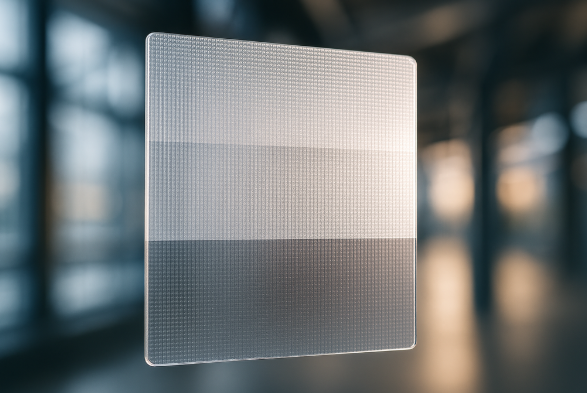
G Series Glare Control and Gain Diffusers

Glare Suppression

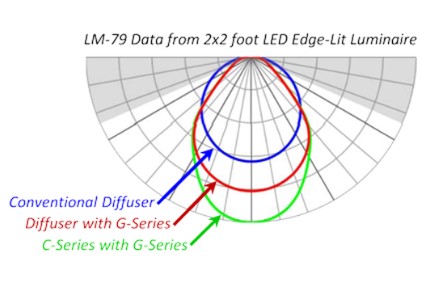
G Series glare control diffusers suppress high-angle light above 65 degrees to reduce visual glare and improve the Unified Glare Rating (UGR) of luminaires. This helps luminaires comply with IESNA RP1-04 and EN12464 glare specifications. These patented² and patent-pending diffusers, unlike conventional prismatic sheets, have a soft cutoff with no color separation, resulting in enhanced visual appeal and LED hiding capability.
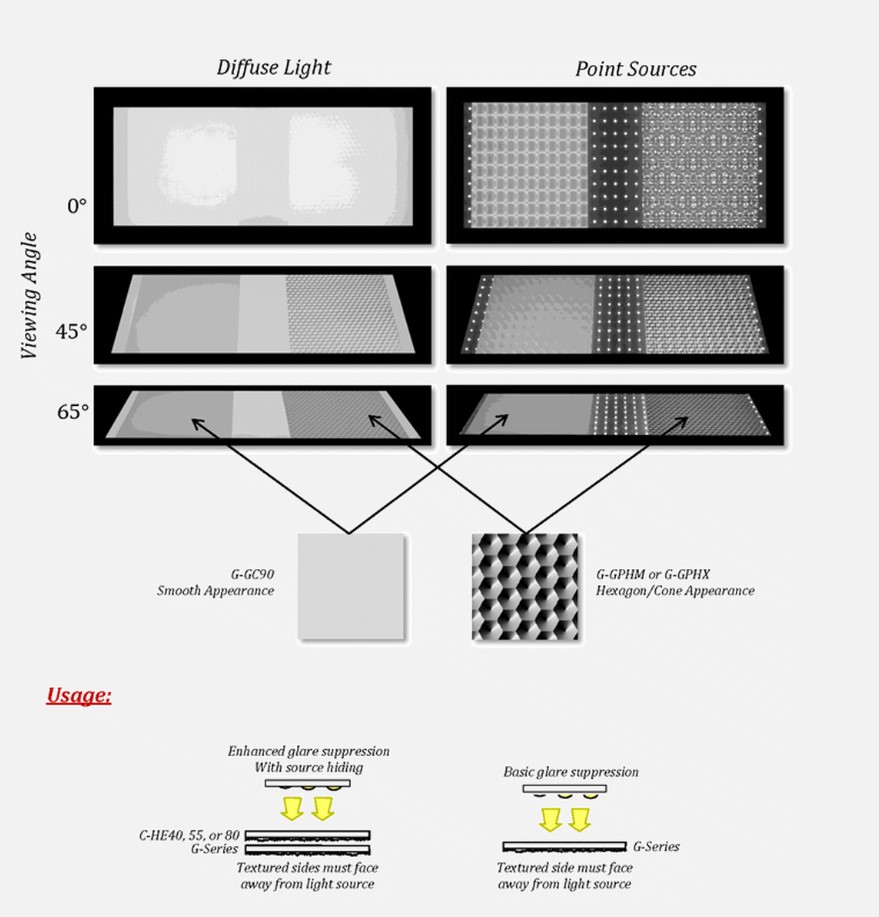
Instructions for use:

  • G Series anti-glare diffusers must be flat to achieve the anti-glare effect; they cannot be curved around the lamp.
  • G Series glare control diffusers must be used with the microstructure facing toward the LED or lamp.
  • Helps luminaires meet ANSI/IESNA RP-1-04 and EN12464 glare standards for office/indoor lighting.
  • Glare suppression and efficiency are typical; they vary significantly depending on luminaire design.
  • BrightView's application engineers can assist with product selection to help your design achieve peak performance.

1Including glare, gain, angle, and efficiencyOpticalPerformance is typical; it varies significantly depending on luminaire design. The results shown were measured in a goniometer using a test fixture with a Lambertian light source.
Frequently Asked Questions

How can classroom lights meet anti-glare standards?
The G Series glare-control diffuser can be used. It suppresses high-angle light above 65 degrees, improves UGR performance, and helps luminaires comply with IESNA RP1-04 and EN12464 glare specifications. During installation, the diffuser must remain flat with the microstructure facing the LED.
Is Eclipse technology a replacement for BrightView's original glare diffuser?
It is not a replacement, but a performance-enhancing product. Eclipse works in coordination with BrightView's existing glare-control structure, directing light toward the axial direction while maintaining high transmittance and a strict cutoff angle, giving lighting designers a new tool to fine-tune luminaires.
What are the installation requirements for anti-glare diffusers?
The G Series anti-glare diffuser must remain flat and must not curve around the lamp, otherwise the anti-glare purpose cannot be achieved; at the same time, when in use, the microstructure must face toward the LED or the lamp.
How is this diffuser different from traditional prismatic sheets?
It features a patented and patent-pending design with a soft cutoff and no color separation, enhancing visual appeal and LED hiding capability, which traditional prismatic sheets do not offer.
With the G Series diffuser, will the luminaire's glare standard be met?
It can help luminaires meet the glare standards of ANSI/IESNA RP-1-04 and EN12464 for office/indoor lighting, but glare suppression and efficiency vary greatly depending on luminaire design. It is recommended that a BrightView application engineer assist with selection to achieve peak performance.