As "eye protection" and "myopia prevention" are mentioned more and more, there are also more and more eye-protection lamps and classroom lamps on the market. But once you really need to choose, you discover - various parameters are hard to understand, advertising claims are all over the place, and prices vary widely. Which ones truly protect the eyes? Which are just gimmicks? This article will help you recognize several major pitfalls of "eye-protection classroom lamps," so you can avoid wasting money and truly protect your child's eyes.
⚠️ Pitfall 1: Only looking at "eye protection" advertising, not at testing standards
Many products advertise "National AA-level illuminance," "no flicker," and "high color rendering index," which sound professional, but is there a test report? Are they implemented according to the **Hygienic Standard for Daylighting and Lighting in Primary and Secondary School Classrooms (GB 7793-2025)**?
👉 Suggestions to avoid pitfalls:
- Check whether the product indicates "Executive standard: GB 7793-2025 Hygienic Standard for Lighting in Primary and Secondary School Classrooms" or "GB/T 40070 Certification Standard for Myopia Prevention and Control Products for Children and Adolescents," etc.;
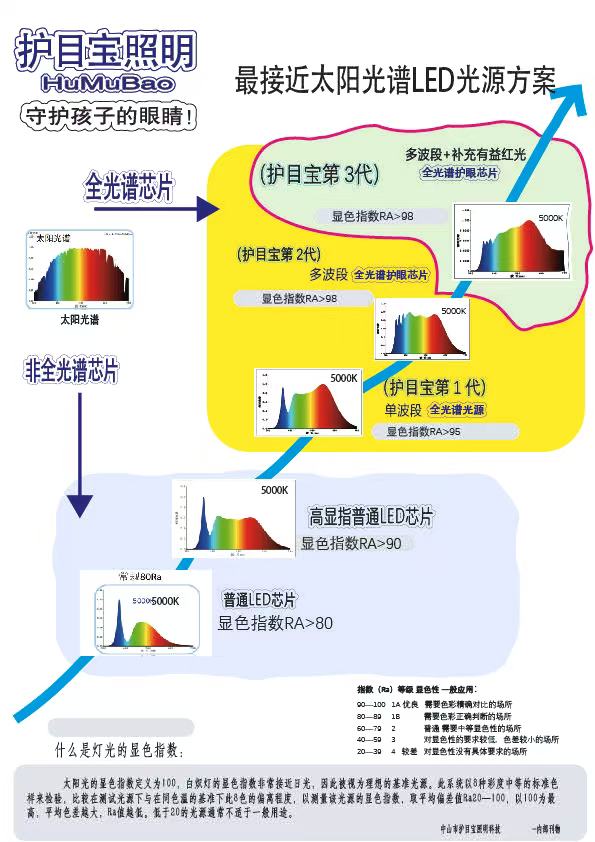
- Check whether there is athird-party test report, especially for key data such as flicker, illuminance, and color rendering index (Ra≥95.R9>80);
- Relying only on the words "eye protection certification" is meaningless; that may just be a title the merchant made up.
⚠️ Pitfall 2: Thinking "bright means good," while ignoring "uniformity" and "glare"
Many parents only think "the lamp should be bright" when choosing lamps, but if the lamp is too bright, the light is uneven, and glare is strong, it can instead easily tire the eyes. This is especially true for classroom lamps: if the center is bright and the sides are dark, children will constantly adjust their visual focus, causing myopia.
👉 Suggestions to avoid pitfalls:
- Check whether "illuminance uniformity" is ≥0.7;
- Check whether the "UGR glare value" is ≤19;
- Try to choose panel lamps with professional optical design, rather than modified ordinary flat panel lamps.
Warning: Pitfall 3: Invisible flicker, but the most harmful to eyes
Some lamps are driven by low-quality power supplies, and the flicker is invisible to the naked eye, but in reality the flicker is severe. Studying under this kind of light for a long time can cause dizziness, visual fatigue, and even vision decline.
👉 Advice to avoid the pitfall:
- Use a phone in slow motion to film the light. If obvious stripes appear, it means the flicker is severe;
- Prefer products withDC drive power supplyand that pass **flicker-free testing (IEEE1789)**;
- Avoid traditional fluorescent lamps or low-quality LED lamps.
Warning: Pitfall 4: Color rendering index (Ra) does not meet the standard, causing color distortion
The higher the color rendering index, the closer the color is to natural light. Lighting with a low CRI makes paper look gray, fonts blurry, and colors distorted, making long reading more straining on the eyes.
👉 Advice to avoid the pitfall:
- Check the parameters: color rendering index Ra ≥ 90;
- Check the light color: the color temperature is recommended to be between 4000K and 5000K, close to daylight;
- Lights that are too white or too yellow are not good for long reading.
Warning: Pitfall 5: Ignoring the installation environment and only replacing the lamp without changing the layout
Some schools or households only replace the lamps without adjusting factors such as fixture spacing, desk reflection, or curtain shading, leaving the overall lighting environment still substandard.
👉 Tips to avoid pitfalls:
- Classroom or study room luminaires should be laid out reasonably, with even light coverage;
- Wall and desk colors should not be too dark, to avoid glare;
- Schools with the means should hire a professional lighting design company to measure light and plan luminaire placement.
⚠️ Pitfall 6: Looking only at price, not lifespan and after-sales service
Some cheap "eye-protection lamps" on the market suffer severe lumen depreciation or driver burnout within a few months. Eye-protection lamps are not disposable items; the key is stability and after-sales support.
👉 Tips to avoid pitfalls:
- Check whether the manufacturer has experience in educational lighting projects;
- Check whether the warranty period is ≥3 years;
- Choose brands with a good reputation; don't be tempted by cheap "unlabeled lamps."
✅ Summary: When choosing eye-protection lamps, look at these five core indicators
| Item | Recommended value | Description |
|---|---|---|
| Executive standards | GB 7793-2025 | National classroom lighting standards |
| Illuminance uniformity | ≥0.7 | Light distribution should be uniform |
| Color rendering index (Ra) | ≥90 | Natural colors without distortion |
| Color temperature | 4000K~5000K | Closest to daylight is most comfortable |
| Flicker | No flicker / DC drive | Anti-fatigue eye protection |
❤️ One final reminder:
A true "eye protection lamp" is not about advertising, but aboutstandards + test reports + light environment design.
Letting children study in soft, stable, and natural light is what true eye protection means.