
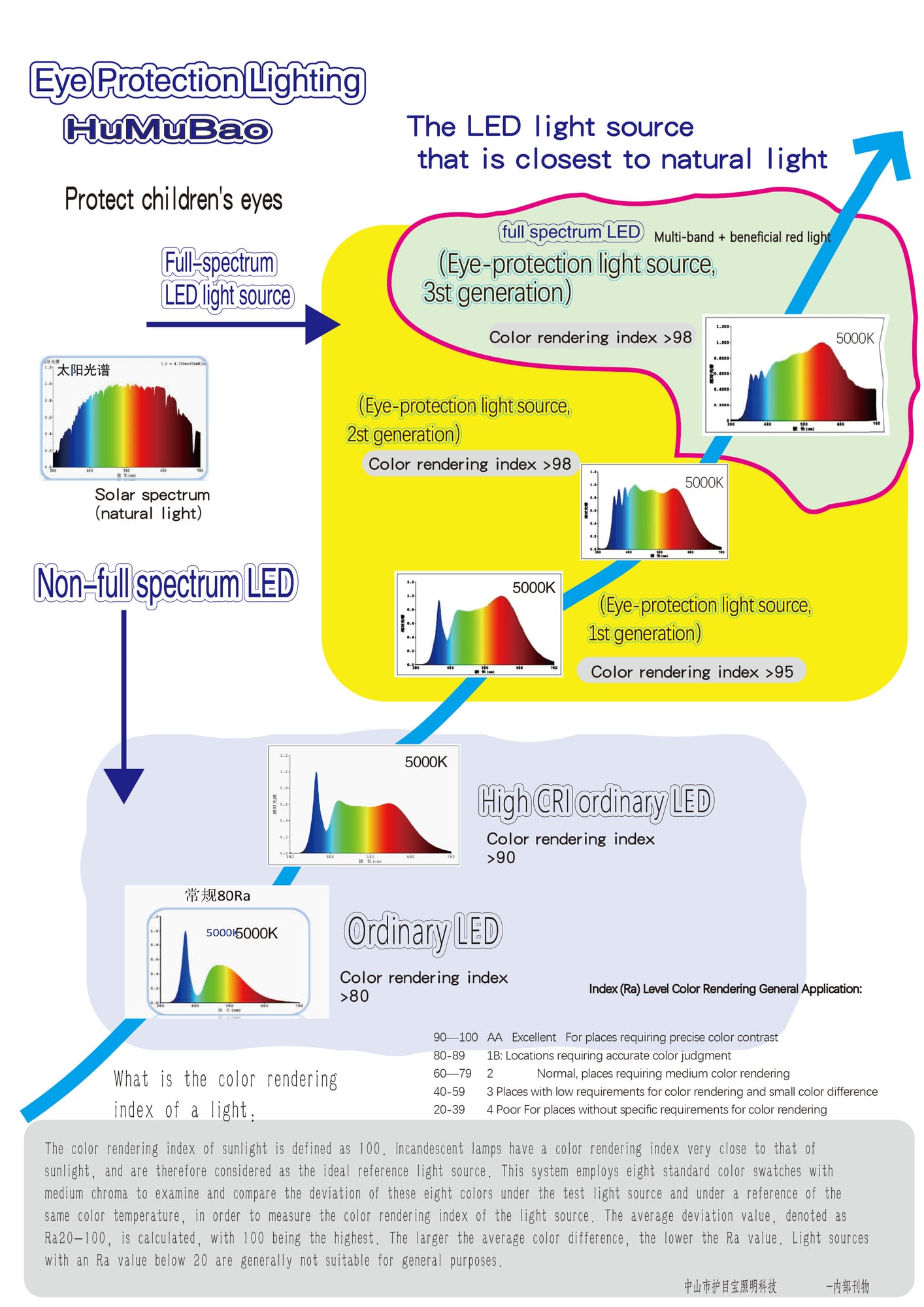
The most important parameter of high-quality lighting fixtures is the color rendering index. Comparison of fixtures with different color rendering indices. Spectral graphs of three different color rendering indices Ra61 Ra92 Ra98 60<Ra>80 Poor 80>Ra<90 Average Ra≥90 Spectral graph
# Exploring Lighting FixturesColor Rendering Index: Illuminating the World of True Colors
In our daily lives, light is everywhere. It not only dispels darkness for us, but also affects our visual perception of the surrounding environment and objects. Among the many indicators for measuring lighting fixture performance,Color Rendering Indexis an important parameter that is often mentioned yet easily overlooked. So, what exactly is lighting fixtureColor Rendering Index? And how does it affect our lives?
## Color Rendering IndexDefinition and Principle
Color Rendering Index, abbreviated as Ra in English, is an indicator that measures a light source's ability to restore the true colors of objects. Simply put, it reflects how closely the colors presented by objects under that light source approximate the colors presented under a standard light source (such as sunlight).Color Rendering IndexThe value range is 0 - 100. The higher the value, the stronger the light source's ability to restore object colors, and the closer the colors presented by objects under this light source are to their true colors.
To understandcolor rendering indexprinciples, we first need to understand the nature of color. Objects appear in various colors because they have different absorption and reflection characteristics for light of different wavelengths. When light strikes an object, the object absorbs light of certain wavelengths and reflects light of the remaining wavelengths. This reflected light enters our eyes, and we perceive the color of the object. Different light sources have different spectral distributions. A standard light source such as sunlight has a continuous and complete spectrum, can illuminate objects evenly, and enables objects to show their truest colors. However, the spectra of artificial light sources are often missing certain components or uneven, which causes the color appearance of objects under these light sources to differ from that under a standard light source.color rendering indexis determined by comparing the color rendering effect of a light source and a standard light source on a series of standard color samples.
color rendering indexclassification and application scenarios
According tocolor rendering indexvalues, we can classify light sources into different grades, and light sources of different grades are suitable for different application scenarios. The image comparison below gives a more intuitive sense of the differences in object colors under differentcolor rendering indexlevels.
Ra≥90
This iscolor rendering indexthe highest grade, meaning that the light source has an excellent ability to restore object colors and can almost achieve the same effect as sunlight.

This type of light source is typically used in places with extremely high requirements for color accuracy, such as art galleries, museums, photography studios, and operating rooms. In art galleries and museums, highColor Rendering Indexlighting allows viewers to appreciate the truest colors of artworks, restoring the artist's original creative intent; in photography studios, accurate color reproduction is crucial for capturing high-quality photos; and in operating rooms, highColor Rendering Indexlighting can help doctors more clearly distinguish the colors of tissues and blood, improving the accuracy and safety of surgery. As can be seen from the image, the colors of objects are vivid and saturated, with clearly distinguishable details, almost identical to what we see under natural sunlight.
80≤Ra<90
This type of light source has good color rendering performance and can reproduce object colors relatively well.

Suitable for most indoor lighting places, such as family living rooms, bedrooms, offices, school classrooms, etc. In the home, highcolor rendering indexlighting can make our home environment warmer and more comfortable, enabling us to perceive the colors of furniture, decorations, and clothing more accurately; in offices and school classrooms, good color rendering performance helps improve people's work and learning efficiency and reduce visual fatigue. Compared with the previous highcolor rendering indeximage, although the color restoration is still relatively high, there may be slight deviations in subtle details, and the color saturation and vividness are also slightly inferior.
60≤Ra<80
Light sources of this grade have average color rendering, with a certain deviation in restoring object colors.

However, it can still be used in locations with low color requirements, such as warehouses, parking lots, stairwells, etc. In these places, the main purpose of lighting is to provide sufficient brightness to ensure safe passage for people, and the requirement for color accuracy is relatively low. As can be clearly seen from the image, the colors of objects become dull, and some color details are difficult to distinguish, showing a noticeable gap from the true colors.
Ra<60
Color Rendering IndexLight sources with a CRI below 60 have poor color rendering, causing noticeable distortion in the colors of objects.

It is generally not suitable for indoor lighting and is mainly used in outdoor locations with almost no color requirements, such as streetlights, construction site lighting, etc. Compared with the previous highColor Rendering Indeximage, the colors of objects here are severely distorted; originally vivid colors become dull and blurry, making it nearly impossible to accurately judge the true colors of objects.
Color Rendering IndexImpact on health and life
Color Rendering IndexIt not only affects our perception of object colors, but is also closely related to our health and quality of life.
Visual health
Long-term exposure tocolor rendering indexlower light sources for living and working, our eyes need to constantly adapt to color deviations, which increases the burden on the eyes and easily leads to problems such as visual fatigue and myopia. In contrast, highcolor rendering indexlight sources can provide a more realistic and natural visual environment, helping to reduce eye fatigue and protect our eyesight. From the comparison of the images with differentcolor rendering indexabove, one can imagine that in a lowcolor rendering indexenvironment, the eyes have to work hard to distinguish colors, while in a highcolor rendering indexenvironment, the visual experience is more comfortable.
Emotion and psychological state
Color has an important impact on our emotions and psychological state. In highColor Rendering IndexUnder light with a high color rendering index, the colors of objects appear more vivid and true, creating a bright and comfortable atmosphere that makes people feel pleasant and relaxed. In contrast, lowColor Rendering Indexlighting can make the environment appear dim and oppressive, potentially causing anxiety, depression, and other negative emotions. When we see vivid images under highColor Rendering Indexlight, we feel cheerful; while seeing images with distorted colors under lowColor Rendering Indexlight, we may feel depressed.
Quality of Life
In daily life, we hope to see the truest colors of objects, whether appreciating a beautiful painting, choosing a suitable piece of clothing, or enjoying a delicious meal. HighColor Rendering Indexluminaires allow us to better enjoy the beauty in life and improve our quality of life. Just as appreciating a painting under highColor Rendering Indexlight, we can more truly feel the painter's creative intent and the charm of colors; while under lowColor Rendering IndexUnder the light, the beauty of the painting is greatly diminished.
How to choose the rightcolor rendering indexlighting fixtures
When choosing lighting fixtures, we should select the appropriatecolor rendering indexaccording to different usage scenarios and needs.
Clarify the usage scenario
First, determine the place where the lighting fixture will be used, whether it is a living room, bedroom, kitchen, bathroom, or office, shopping mall, exhibition hall, etc. According to different scenarios, determine the requiredcolor rendering indexlevel. Generally speaking, for home lighting, it is recommended to choose lighting fixtures with Ra≥80, while for some special places with high color requirements, lighting fixtures with Ra≥90 should be chosen.
Check product parameters
When purchasing lighting fixtures, carefully check the product manual or label to understand thecolor rendering indexand other related parameters of the lighting fixture. At the same time, pay attention to choosing reputable brands and products with quality assurance to ensure the performance and quality of the lighting fixtures.
On-site experience
If conditions permit, before purchasing lighting fixtures, you can visit a lighting showroom or the actual place of use for an on-site experience, observe the color performance of objects under the light, and feel the comfort and effect of the lighting.
Lighting fixturesColor rendering indexis an important indicator that cannot be ignored, as it directly relates to our perception of object colors, visual health, and quality of life. When choosing lighting fixtures, we should fully understandcolor rendering indexmeaning and importance, and choose the appropriatecolor rendering indexlighting fixtures according to actual needs, so that lighting can better serve our lives and illuminate a true, brilliant world of color.