Primary and secondary school classroom lighting is crucial to students' visual health and learning environment. China currently has several standards related to primary and secondary school classroom lighting, which are introduced in detail below:

2025-03-05 · Industry News

Hygienic Standard for Daylighting and Artificial Lighting in Primary and Secondary School Classrooms (GB 7793-2010) Issue date: effective from February 1, 2011. Main contents Daylighting requirements: It specifies that classrooms should give priority to the use of natural daylighting. Artificial lighting should be provided for classroom desks and blackboards. Classrooms with unilateral daylighting

Quick Answer

China's current primary and secondary school classroom lighting primarily follows three national standards: GB 7793-2010 "Hygienic Standard for Day Lighting and Artificial Lighting for Primary and Secondary Schools" took effect on February 1, 2011; GB/T 36876-2018 "Technical Specification for School Classroom Lighting" took effect on July 1, 2019; and GB 40070-2021 "Hygienic Requirements for Myopia Prevention and Control of Children and Adolescents' Learning Supplies" took effect on December 1, 2022.

Hygienic Standard for Daylighting and Lighting in Primary and Secondary School Classrooms (GB 7793-2010)

  • Issue Date: Implemented from February 1, 2011.
  • Main Content
    • Daylighting Requirements: It specifies that classrooms should prioritize the use of natural daylighting. Artificial lighting should be provided for classroom desk surfaces and blackboards. For classrooms with unilateral daylighting, light should enter from the left side of student seats; for classrooms with bilateral daylighting, the main daylighting window should be located on the left side. The window-to-floor area ratio of classrooms should not be less than 1:5.
    • Lighting Requirements: The average illuminance on classroom desk surfaces should not be less than 300lx, and the illuminance uniformity should not be less than 0.7. Blackboards should be equipped with local lighting fixtures, with an average vertical illuminance of not less than 500lx and illuminance uniformity of not less than 0.8.

Technical Specification for School Classroom Lighting (GB/T 36876-2018)

  • Issue Date: Implemented from July 1, 2019.
  • Main Content
    • Lighting Quality: It specifies parameters such as color temperature and color rendering index for classroom lighting. The correlated color temperature of classroom lighting sources should be 3300K-5300K, and the color rendering index should not be less than 80.
    • Flicker and Blue Light Hazard: It limits the flicker and blue light hazards of lighting fixtures. It requires that the flicker percentage of classroom lighting fixtures should not exceed 3.2%, and the blue light hazard group should not exceed RG1.
    • Layout and Installation: It specifies the layout and installation requirements for classroom lighting fixtures. For example, lighting fixtures should adopt direct-type luminaires with batwing light distribution characteristics, and the luminaire layout should be arranged parallel to classroom desks.
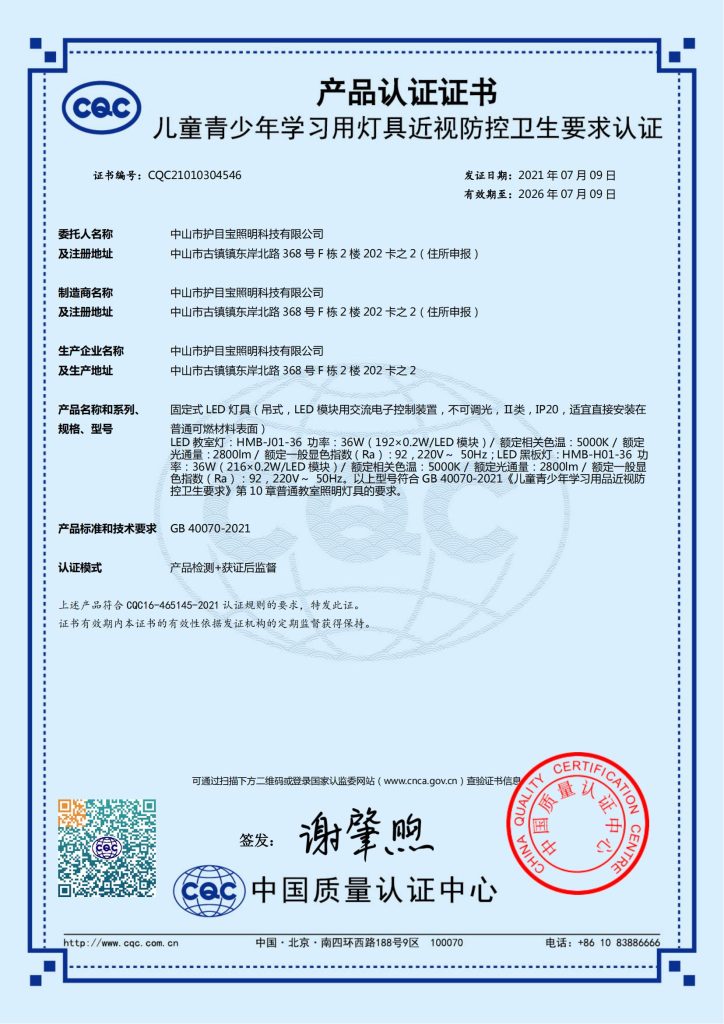
Hygienic Requirements for Myopia Prevention and Control of Children and Adolescents' Learning Supplies (GB 40070 - 2021)

  • Issue Date: Effective from December 1, 2022.
  • Main Content: Although this standard is a comprehensive standard, it also involves some requirements for classroom lighting. Focusing on myopia prevention and control, it emphasizes the impact of the lighting environment on the vision of children and adolescents, and further standardizes and refines various indicators of classroom lighting to create a learning environment conducive to the visual health of children and adolescents.
Frequently Asked Questions

Which national standards currently apply to primary and secondary school classroom lighting?
There are mainly three: GB 7793-2010 "Hygienic Standard for Day Lighting and Artificial Lighting for Primary and Secondary Schools," effective February 1, 2011; GB/T 36876-2018 "Technical Specification for School Classroom Lighting," effective July 1, 2019; and GB 40070-2021 "Hygienic Requirements for Myopia Prevention and Control of Children and Adolescents' Learning Supplies," effective December 1, 2022.
Which classroom lighting standard specifically addresses myopia prevention and control?
GB 40070-2021 "Hygienic Requirements for Myopia Prevention and Control of Children and Adolescents' Learning Supplies" approaches the issue from a myopia prevention and control perspective, emphasizing the impact of the lighting environment on children's and adolescents' vision, and further standardizes and refines various classroom lighting indicators. It took effect on December 1, 2022.
When did GB 7793-2010 take effect?
The Sanitary Standard for Daylighting and Artificial Lighting in Primary and Secondary School Classrooms (GB 7793-2010) has been in effect since February 1, 2011. It explicitly states that classrooms should prioritize the use of natural daylight, and artificial lighting should be provided for classroom desks and blackboards.
In which year did the Technical Specification for School Classroom Lighting GB/T 36876 come into effect?
The Technical Specification for School Classroom Lighting (GB/T 36876-2018) came into effect on July 1, 2019, and is one of the current standards related to classroom lighting in primary and secondary schools.